INTERNATIONAL CONFERENCE | CALL FOR PAPERS
University of Regensburg, March 3–5, 2027
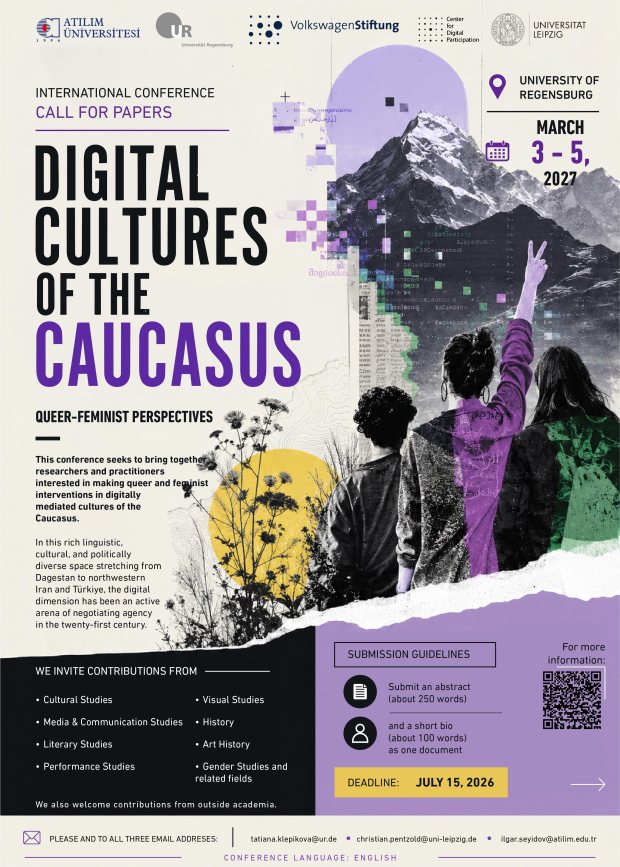
Poster design: Sara Alara Güneş and Furkan Alkaç
This conference seeks to bring together researchers and practitioners interested in making queer and feminist interventions in digitally mediated cultures of the Caucasus. In this rich linguistic, cultural, and politically diverse space stretching from Dagestan to northwestern Iran and Türkiye, the digital dimension has been an active arena of negotiating agency in the twenty-first century. Multiple diasporas around the world further enrich the complexity of digital imaginaries, participation, and belonging in the Caucasus.
We invite contributions from across Cultural Studies, Media and Communication Studies, Literary Studies, Performance Studies, Visual Studies, History, Art History, Gender Studies, and adjacent fields, as well as from outside academia, that critically engage with digital culture, politics, and society in the Caucasus. How do, for instance, regimes of visibility and opacity shape digital cultures across the Caucasus and in the diaspora? How could practices of surveillance, policing, and their contestations inform our analytical approaches to regional digital ecosystems? And how might we conceptualize the “gaze” across geopolitical and cultural terrains?
Further, we welcome submissions that explore embodied economies of the digital in this region, from sex work and migrant labor in platform-based industries like food delivery, to high-revenue influencer cultures. How could an engagement with infrastructures and affordances that undergird them shape our understanding of precarity, affluence, and marginalization? How are we to approach digital cultures of intimacy, desire, and care in the Caucasus?
We also seek to examine the various forms that digital mobilization of values takes across the region and within diasporas. How are power hierarchies and norms mediated through varied religious and secular cultures? How do digital cultures destabilize and reproduce them? What is the role of digital cultures in shaping and contesting dominant narratives from the queer-feminist perspective? How are memory cultures and the canon of the body negotiated in the digital era? And how does it all affect digital democracies, activism, and rights advocacy in the broader Caucasus?
The conference language is English. Please submit an abstract of about 250 words and a short bio of about 100 words (as one document) by July 15, 2026, to the organizers at all three email addresses listed below:
tatiana.klepikova@ur.de; christian.pentzold@uni-leipzig.de; ilgar.seyidov@atilim.edu.tr
Notes of acceptance will follow in August. Our discussions at the conference will be based on internally pre-circulated papers (under this format, we include academic contributions as well as essay reflections on artistic practice). Participants will need to submit their papers of 2,000 words by January 31, 2027, to enable enough time for everyone to read each other’s work. Following the conference, we will invite select authors to further develop their contributions for an edited volume in a peer-reviewed book series.
The conference will be held in person in Germany. The organizers have secured limited funding to support travel costs and cover accommodation for participants, with priority given to early-career researchers, scholars based in the region, and practitioners. We recognize that personal and professional situations may vary and are open to considering hybrid participation in exceptional cases. If you are unable to participate in person, please note this information in your submission.
For any questions, please reach out to Tatiana Klepikova at tatiana.klepikova@ur.de.
Conference organizers:
Tatiana Klepikova
University of Regensburg | Research group on Queer Literatures and Cultures under Socialism
Christian Pentzold
University of Leipzig | Center for Digital Participation
Ilgar Seyidov
Atılım University | Department of Public Relations and Advertising

